Clickable chart
El Chalten day tour weather, season by season
The year under Fitz Roy
El Chaltén through the year
Choose a month to see sunset, daylight and what the season brings in the village.
Sunset
Jan
- Sunset roughly at 21:54
- What the month brings: Summer, windy1
Midsummer: the park's strongest winds, and every trail and bus is running.3,7
Feb
- Sunset roughly at 21:13
- What the month brings: Summer, windy1
Still windy summer; the walking border crossing from Lago del Desierto is open.8
Mar
- Sunset roughly at 20:18
- What the month brings: Autumn color1
Autumn color begins, and the trekking festival usually falls mid-month.12,9
Apr
- Sunset roughly at 19:12
- What the month brings: Late autumn1
The park's recommended season ends; village services run until Holy Week.1,7
May
- Sunset roughly at 18:21
- What the month brings: Winter rules1
Winter rules begin: crampons, poles and trail registration.4,10
Jun
- Sunset roughly at 17:58
- What the month brings: Snow, cold1
Snow is heaviest in the coldest months; check the road before you travel.3,26
Jul
- Sunset roughly at 18:13
- What the month brings: Snow, cold1
Deep winter: the park's lower areas average 0.6 °C in this season.2
Aug
- Sunset roughly at 18:53
- What the month brings: Snow, cold1
Studded tires or approved chains are compulsory on park roads in winter.27
Sep
- Sunset roughly at 19:36
- What the month brings: Season opens1
The visiting season opens, but winter trail rules still apply this month.1,4
Oct
- Sunset roughly at 20:21
- What the month brings: Services return1
Village services return and Route 40 buses to Bariloche start.7,15
Nov
- Sunset roughly at 21:13
- What the month brings: Spring1
The walk into Chile from Lago del Desierto opens for the summer.8
Dec
- Sunset roughly at 21:53
- What the month brings: Early summer1
Early summer: lower areas average 13.4 °C in this season, with gusty days.2,3
Sunset is worked out for the 15th of each month on Argentina time. Season notes come from Los Glaciares National Park and the El Chaltén tourism office, not from a weather station: none reports from the village.
An El Chalten day tour lives or dies by the sky. Here is what the national park and the town say about the seasons, the wind and the cloud on Fitz Roy, and how to dress for all of it.
Editorial team, elchaltendaytrip.top · Updated November 9, 2026 · Quick read: 9 min
Quick look
- Best monthsSeptember to April, the park's recommended visiting season.1
- TemperaturesMean of 0.6 °C in winter and 13.4 °C in summer in the park's lower areas.2
- WindStrongest in summer; snow is heaviest in the coldest months.3
- Winter trailsIce, mud and snow from May to September; crampons and poles required.4
- Pack forAll 4 seasons in one day, as the tourism office puts it.5
Why the weather decides an El Chalten day tour
On an El Chalten day tour you get one afternoon under the mountains, so the sky matters more than on almost any other excursion in the region. The guided day spends about 5 hours in and around the village, and the views of Fitz Roy and Cerro Torre that make the trip are promised only for clear days. A cloudy afternoon still gives you the steppe, Lake Viedma and the village, but not the skyline on the postcards.
The park cautions that the weather can turn abruptly in every season.6 The town's tourism office says something similar in a more memorable way: on a single day you may live through all 4 seasons of the year.5 Both are true in practice. A bright morning in El Calafate can become a grey, windy noon in the village, and a lost summit can reappear in minutes when a gap opens in the cloud.
That is why this page is about patterns rather than a promise. A forecast for the El Chalten weather on your date helps, and Argentina's national weather service and the park's visitor center are the places to check it, but no forecast can guarantee a clear peak in mid-afternoon. Book an El Chalten one-day tour with free cancellation, watch the outlook for a few days and keep a second date in mind if your trip allows it.
The year at a glance
El Chaltén through the seasons
| Season | What the park and town say | For a day tour |
|---|---|---|
| September to November | Visiting season opens; services from October | Quieter, check what is open |
| December to February | Mildest months, strongest winds | Most daylight, dress for gusts |
| March and April | Autumn colors, festival in mid-March | Calmer and colorful |
| May to August | Cold, heavy snow, crampons on trails | Possible, with spare days |
Season notes compiled from the park's climate and season information and the village tourism office.1,7,3,12,9,13,4
The park's climate in a few numbers
The national park describes its climate as temperate to cold and humid. In the lower areas, where the village and the roads lie, mean temperatures run from 0.6 °C in winter to 13.4 °C in summer, while the high mountain zones would average around -3 °C over the year.2 There is no weather station inside El Chaltén itself whose record we can show, so treat these park-wide figures as the honest guide.
Rain is lighter than the green forests suggest. The park counts 500 to 900 mm a year on average, rising from the dry steppe in the east to the mountains in the west, and spread fairly evenly through the year.11 You can see the gradient on the drive: bare plains and low shrubs around Lake Viedma, then lenga woods closing in as the road nears the range. Showers in the village are often short and blown through by the wind, so a rain jacket usually beats an umbrella.
Snow and wind follow opposite calendars. Snowfall is heavy in the coldest months, and the strongest winds blow in summer.3 For a visitor that means summer is mild but blustery, winter calmer but white and cold. Neither of them should keep you at home; each simply calls for a different plan and different clothes, which the rest of this guide sets out season by season. If you can choose freely, the shoulder of each season often gives the best balance of light, wind and quiet trails.
Through the year
How the season opens and closes
September
Season opens
The park's recommended window begins.1
October
Services return
Basic tourist services run regularly from October.7
November
Border walk opens
The crossing from Lago del Desierto opens until March.8
Mid-March
Trekking festival
The town celebrates the 1948 Fitz Roy expedition.9
Holy Week
Services wind down
The regular season of services ends.7
May
Winter rules
Spring and summer, September to February
The park recommends September to April for a visit, and notes that summer winds are intense.12 In practice spring and summer are when the trails, buses and tours all run, and when the day tour has the most daylight to play with. The village's basic tourist services operate regularly from October, so September can still feel quiet, with some places not yet open.7 Late snow can linger on the higher paths early in the season, so ask at the visitor center before setting off on a long trail.
Summer also opens routes that are closed in other months. The walking crossing from Lago del Desierto into Chile at boundary marker IV is open from November to March.8 Buses to Bariloche along Route 40 operate on several days a week, but only between October and April.15 If your trip depends on either, summer is the only real option. It is also the busiest stretch of the year, so seats on buses and tours sell out sooner than in the shoulder months.
The trade-off is wind. A summer gust on the Los Cóndores viewpoint or along Lake Viedma can be strong enough to stop you in your tracks, and it carries dust and cold even on sunny days. Plan photographs for the calmer moments, keep hats on a cord or in a pocket, and expect the coach to rock on the open steppe. It is the price of the best months, and most people find it part of the experience.
When should you go?
Pick the month for your trip
Weigh what you want against wind and snow.
If I want every trail and bus running
December to February
Village services keep regular hours from October to Holy Week.7
If I want color and fewer gusts
March or April
Autumn brings yellows, ochres and reds.12
If I want to walk into Chile
November to March
The Lago del Desierto crossing is open then.8
If I want snow scenes
May to August, with crampons
Crampons and poles are compulsory on the trails.4
If I want the trekking festival
Mid-March
Races and a craft fair in the village.14
Autumn, March and April
Autumn has a strong case of its own. The park points out that in autumn the vegetation turns into a patchwork of yellows, greens, ochres and reds against the Andes and the turquoise lakes.12 The lenga forests on the way to Chorrillo del Salto and Laguna Capri turn with the season, and the light is lower and warmer than in midsummer. Mornings are colder, so start a little later on frosty days and let the sun reach the trails.
March brings the village's own celebration. Each March, usually mid-month, the National Trekking Festival recalls the first Argentine bid for Fitz Roy, made on 18 March 1948.9 Its races include the Bajada del Torre, a trekkathon of about 11 kilometres, and the Desafío de los Campamentos of about 27 kilometres.22,23 Expect a busier village and book beds early if your dates overlap. Day visitors can watch part of the festivities before the coach leaves, which adds something different to the afternoon.
By April the season is closing. The park's recommended window ends that month, and the regular season of basic services runs only until Holy Week, which moves with Easter each year.1,7 Days shorten quickly, and the tourism office's advice to find out when it gets dark before starting a walk becomes important.21 For a day tour, autumn is a good compromise: calmer, colorful and quieter.
Book for the season
Price an El Chaltén day in summer or winter
Select an outing and the number of travelers.
Compare 3 choices
Price an El Chaltén day in summer or winter
Select an outing and the number of travelers.
- Guided day tour11 hrs · starts at, per person $117
≈
View - Capri trek with picnic13 hrs · starts at, per person $120
≈
View - Winter Capri trek10 hrs · starts at, per person $270
≈
View
Starting prices from GetYourGuide, converted at the ECB reference rate. You will see the exact price when booking.
Winter, May to September
In the park's description, the stretch from May to October is the cold part of the year, with low temperatures and heavy snowfall, mostly in winter, that limit access to some activities and trails.13 Through the months from May to September, the park requires crampons and walking poles, since the trails turn icy, snowy and muddy.4 The trail leaflet adds that snow and mud raise the difficulty of every route.24 A walk that takes a gentle afternoon in January can become a serious outing in July, so cut your plans down rather than stretch them.
Winter also changes the paperwork. Registration at the park's information center, normally needed only for climbing and remote trekking, becomes compulsory for the ordinary trails from May to September.10 Walking or skating on frozen lagoons is forbidden at any time.25 If you want a guide, one winter listing leads Laguna Capri treks for groups capped at 10 people.
The road can be the bigger problem. The tourism office warns that winter snowstorms can cut the routes, so leave spare time, check which lodgings are open and drive only with chains or studded tires on snow or ice.26 In the park itself, studded tires or approved chains are compulsory in winter.27 A winter day tour can be beautiful, but plan it with a margin and a flexible booking. Short daylight also leaves less time in the village, so keep the walks short and the pace steady.
Video
An El Chalten travel guide for Patagonia
Before You Go on YouTube · Tap play to load the video; not before.
On average there are 500 to 900 mm of rain a year, from east to west, spread fairly evenly through the year.
Weather kit
Pack for every season in a day
Wind, cloud and the view of Fitz Roy
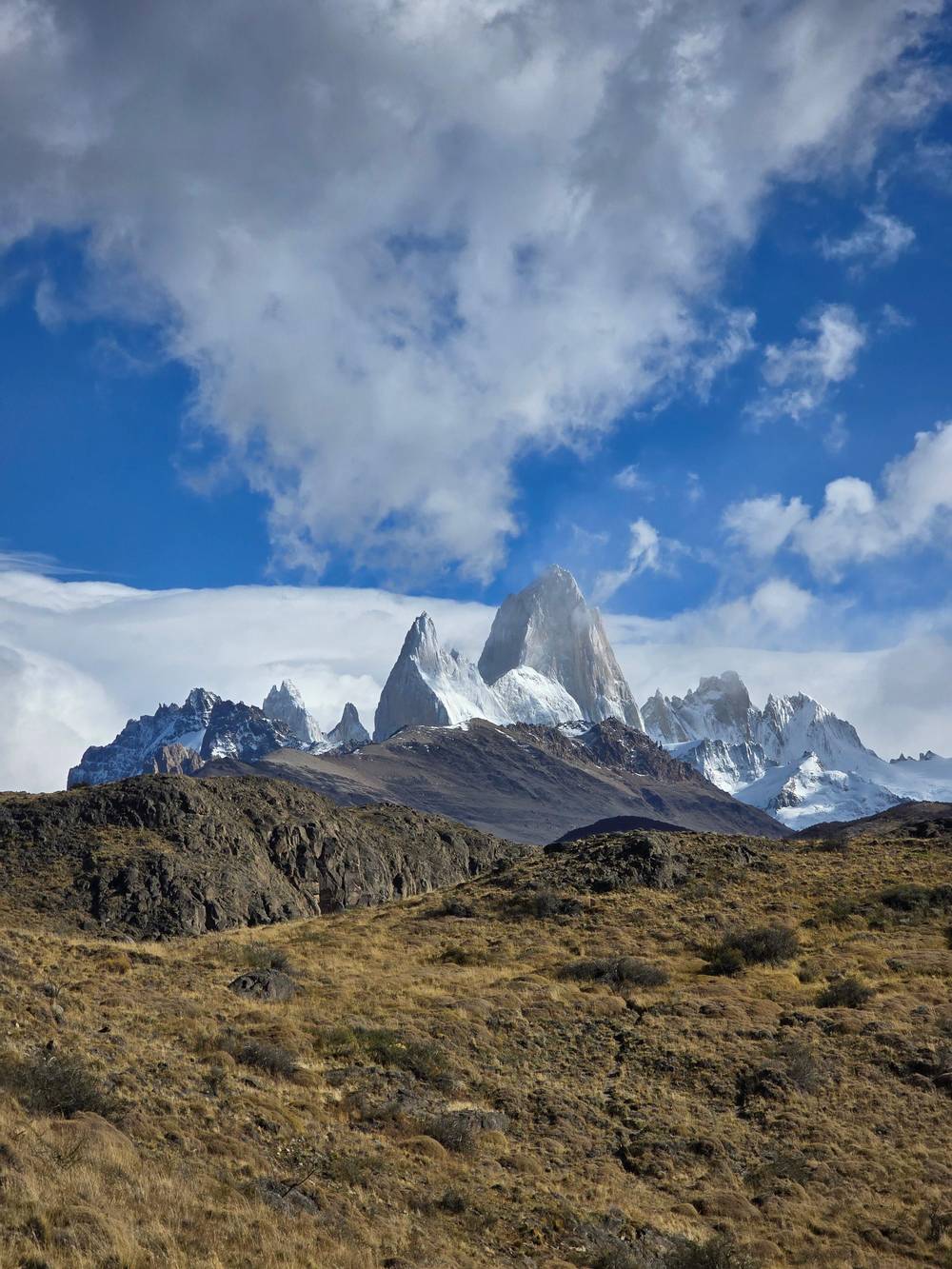
The mountain's own name is a weather report. In the Tehuelche language Chaltén means a smoking mountain, because the first people here took the cloud-capped peak for a volcano.28 The municipality adds that the word also carries the senses of a bluish mountain and of a sawn edge, for the jagged outline.29 Each of them describes what you are likely to see: a blue-grey ridge that smokes with cloud.
The park's trail leaflet makes a point every visitor learns quickly: the weather in the village is different from the weather in the mountains.30 A calm, sunny street can sit below a summit lost in a storm, and the reverse happens too. When you arrive on a day tour, look up first and photograph the peak if it is clear, because the next hour may close it. Do not judge the whole afternoon by the first view from the coach window.
Patience pays. Cloud on this range moves fast in the wind, so a gap can open while you eat lunch or walk to the waterfall. Keep your camera ready on the return leg too: the stretch along Lake Viedma can give a last look at the skyline from a distance, sometimes clearer than the view from the village itself. Treat any glimpse as a gift rather than a promise. Sit on the side of the coach facing the range on the way home and keep the lens cap off.
What to wear and carry in any month
Dress in layers whatever the month. The park recommends onion-style layers against the cold wind and the chilly evenings, summer included, and singles out a light, waterproof wind shell as the one item no Patagonia visitor should be without.16 The tourism office's list for El Chaltén adds trekking or comfortable shoes, a warm fleece, sunglasses, a hat, gloves and sunscreen.19 Choose a jacket with a hood you can close tightly; on the open viewpoints the wind finds every gap.
Sun protection matters more than people expect. The air is clear and dry, and the tourism office asks visitors to protect their eyes with UV-filter glasses.18 Wind dries skin and lips fast, so lip balm and a light buff for the face are worth the pocket space. Gloves are not optional on the viewpoints in any month, and a warm hat fits in a jacket pocket. If you forget something, the village has shops that sell and rent outdoor clothing.31
For hikes rather than the short day tour walks, the park asks you to carry water, food, a spare warm layer and a torch, because there are no shops on the trails.20 It also advises shoes that hold the ankle on rough ground.17 Whatever the forecast says in the morning, pack as if it will change by noon, because it often does. Pack the spare fleece in a waterproof sack so a downpour cannot soak it.
FAQ
Questions answered quickly.
Which months suit an El Chalten day tour best?
How cold is El Chalten?
In the park's lower areas mean temperatures run from 0.6 °C in winter to 13.4 °C in summer.2
Does it rain a lot in El Chalten?
The park averages 500 to 900 mm a year from east to west, spread fairly evenly.11
When is it windiest?
The park notes stronger winds in summer and heavy snow in the coldest months.3
Can I visit El Chalten in winter?
From May to September trails carry ice and snow; poles and crampons are compulsory.4
Will clouds hide Fitz Roy?
Its Tehuelche name means smoking mountain, after the clouds that cap it.28
Where can I check the forecast?
Check Argentina's weather service and ask at the park visitor center; mountain and village weather differ.30
Sources
- National Parks Administration, Los Glaciares National Park · Biodiversidad ↩
- National Parks Administration, Los Glaciares National Park · Biodiversidad ↩
- National Parks Administration, Los Glaciares National Park · Biodiversidad ↩
- National Parks Administration, Los Glaciares National Park (argentina.gob.ar) · Recomendaciones para visitar el Parque Nacional Los Glaciares ↩
- Secretaria de Turismo de El Chalten (municipal tourism office) · Recomendaciones ↩
- National Parks Administration, Los Glaciares National Park · Recomendaciones para visitar el Parque Nacional Los Glaciares ↩
- Secretaria de Turismo de El Chalten, the town tourism office (elchalten.tur.ar) · Recomendaciones (advice for visitors) ↩
- Secretaria de Turismo de El Chalten (municipal tourism office) · Lake Trips ↩
- Municipalidad de El Chalten · Fiesta Nacional del Trekking ↩
- National Parks Administration, Los Glaciares National Park (argentina.gob.ar) · Actividades ↩
- National Parks Administration, Los Glaciares National Park · Biodiversidad ↩
- National Parks Administration, Los Glaciares National Park (argentina.gob.ar) · Panoramica ↩
- National Parks Administration, Los Glaciares National Park (argentina.gob.ar) · Panoramica ↩
- Municipalidad de El Chalten · Fiesta Nacional del Trekking ↩
- Secretaria de Turismo de El Chalten, the town tourism office (elchalten.tur.ar) · Omnibus (getting there by bus) ↩
- National Parks Administration, Los Glaciares National Park (argentina.gob.ar) · Panoramica ↩
- National Parks Administration, Los Glaciares National Park · Recomendaciones para visitar el Parque Nacional Los Glaciares ↩
- Secretaria de Turismo de El Chalten (municipal tourism office) · Recomendaciones ↩
- Secretaria de Turismo de El Chalten (municipal tourism office) · Recomendaciones ↩
- National Parks Administration, Los Glaciares National Park (argentina.gob.ar) · Recomendaciones para visitar el Parque Nacional Los Glaciares ↩
- Secretaria de Turismo de El Chalten, the town tourism office (elchalten.tur.ar) · Recomendaciones (advice for visitors) ↩
- Municipalidad de El Chalten · Fiesta Nacional del Trekking ↩
- Municipalidad de El Chalten · Fiesta Nacional del Trekking ↩
- National Parks Administration, Los Glaciares National Park (North Zone trail leaflet, PDF) · Los Glaciares National Park North Zone trails leaflet (English PDF) ↩
- National Parks Administration, Los Glaciares National Park · Recomendaciones para visitar el Parque Nacional Los Glaciares ↩
- Secretaria de Turismo de El Chalten, the town tourism office (elchalten.tur.ar) · Recomendaciones (advice for visitors) ↩
- National Parks Administration, Los Glaciares National Park (argentina.gob.ar) · Recomendaciones para visitar el Parque Nacional Los Glaciares ↩
- National Parks Administration, Los Glaciares National Park (argentina.gob.ar) · Panoramica ↩
- Municipalidad de El Chalten · El Chalten ↩
- National Parks Administration, Los Glaciares National Park (argentina.gob.ar) · Los Glaciares National Park North Zone trail leaflet (PDF, English, 2024) ↩
- Secretaria de Turismo de El Chalten, the town tourism office (elchalten.tur.ar) · Recomendaciones (advice for visitors) ↩
Read next